I offer my advanced level of legal assistance.
23K+
Critical cases solved
successfully
14+
Awards
achievement
My practice area
Case Study
Lawyer of the year
Following Valley’s demise in 1924, the legal firm adopted the name “The Law and Royalty-Free Company.”
⭐ Worked With world top companies ⭐
Nevine Acotanza
Chief Operating OfficerChief Operating Officer
Mar 4, 2015 - Aug 30, 2021 testMr. Lee displayed remarkable responsiveness, professionalism, expertise, and proficiency. He swiftly grasped the intended concept and guided me in creating an elegant and captivating presentation.
Jone Duone Joe
Operating OfficerOperating Officer
Mar 4, 2016 - Aug 30, 2021Sarah exhibited remarkable responsiveness, professionalism, knowledge, and expertise. She quickly understood the intended concept and guided me in creating a sleek and aesthetically pleasing presentation.
Nevine Dhawan
CEO Of OfficerCEO Of Officer
Mar 4, 2016 - Aug 30, 2021Maecenas finibus nec sem ut imperdiet. Ut tincidunt est ac dolor aliquam sodales. Phasellus sed mauris hendrerit, laoreet sem in, lobortis mauris hendrerit ante. Ut tincidunt est ac dolor aliquam sodales phasellus smauris
Join With Us

Jessia Urmi
Junior lawyer

Devid Lee
Senior Attorney

Brett Sam
General Attorney

Florina Gomez
Junior lawyer

William Van
General Lawyer
Contact With Me
Nevine Acotanza
Chief Operating OfficerI am available for freelance work. Connect with me via and call in to my account.
Phone: +012 345 678 90 Email: admin@example.comMy advice to people.
It’s the Destination that informs the Journey.
As humans, we were created with this innate curiosity to do and accomplish more than what we currently have. It’s that drive to explore and see what’s on the other side of the world. It’s the inquisitiveness to experience if we will actually fall off at the end of the flat earth once we reach the edge.
Although it may be intimidating to constantly hear of people who have their 10-step plan, and know exactly what they want in 5 years, have long and short-term plans, you too can achieve a lot of what you desire with the necessary action.
Some simple steps to move towards your desired destination
1. Have at least 1 thing that you are working towards
This step is sort of your guiding star. It is often said that life is about the journey more than the destination and that once you arrive at your destination, the journey starts again. I find this statement true, and for the journey to actualize there must be a desired destination that will inform the starting steps and guiding actions along the journey.
2. Feel free to explore your different interests
This is about trying different things that will help you learn more about yourself and discover various sides of you. The main drive is to not allow yourself to box yourself in. Once you have found what you are good at and enjoy doing, it’s okay to specialize but don’t limit yourself to only what you know. You too can surprise yourself with hidden talents and abilities that are within yourself. Always endeavor to stretch yourself.
3. Commit to excellence
Committing to excellence speaks to you doing what is right and excelling in what you do. This needs to be a part of you and has to inform your brand. Excellence will set you apart in a world full of people and constant self-promotion. Excellence will raise the quality of your relationships and your appeal. It will also lead to people recommending you to those who need the value that you bring. As the wise King Solomon puts it, “A man skillful in his craft will serve before kings”.
4. Invest in your development
You are your most valuable asset, and no one can invest in you as much as you can. There are various ways to develop yourself. This can be in the form of reading, podcasts, formal studies, being part of communities, mentorship, and just having conversations with people who are ahead of you in certain areas. The key is to expose yourself to new learnings and actually put into practice what you have learned so that it sticks and facilitates your growth.
5. Surround yourself with people who will challenge and inspire you to be the best you
This is about motivation and accountability. You need those people in your life who will celebrate you and your achievements, challenge you where you are going astray and show you that there is more to life. Your network is truly your net worth. The genuineness and reciprocity of these relationships will nourish your soul and give you the fuel to keep going when the going gets tough.
6. Start where you are
It’s interesting how we admire stories of people who have “made it” and have this expectation to hear this great and majestic voice of what to do next. When listening to all the stories of those we deem successful, the common thread is that everyone started where they were at, with what they had, and built on that. The compound interest of action is astounding. Constant small actions good or bad will over time yield great rewards or consequences and the key is to invest in the right actions.
On our way to our destination, the journey or process is the most valuable. At the end of it all, we treasure the experience we gain and the relationships and connections we build along the way. The destination is the compass whilst the journey is our life story. Keep taking those steps in your life story.
Building your business for scale.
Ever wondered why some businesses grow over time and become very good at what they do? As business owners, we are faced with many interesting challenges. Core to this is being the visionary and the main driver to bring the vision to life. With a small to medium enterprise, there are many balls to juggle as you build your enterprise and your team. You can easily find yourself being all things to all men, as you may be core in most of the departments within the business, which does not lend itself well to growth and scale.
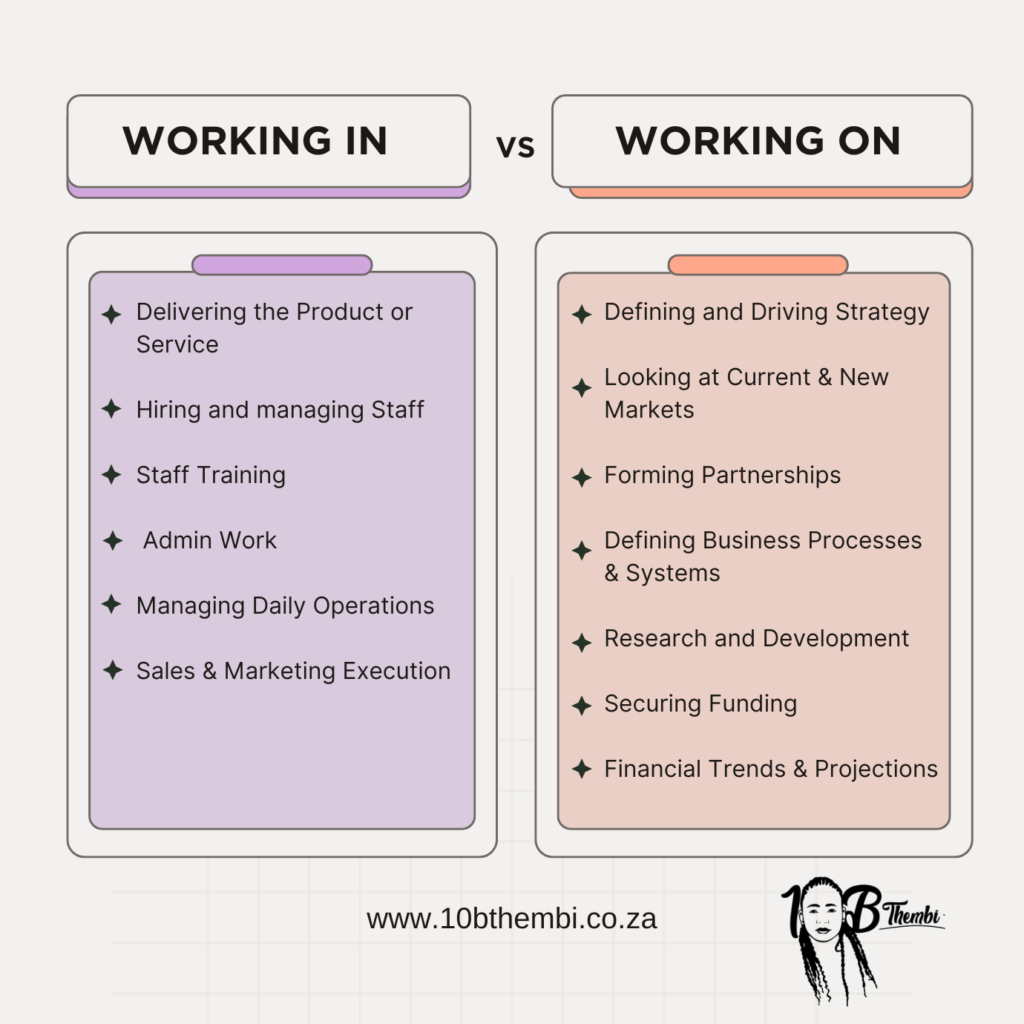
Here enters the concept of working IN versus working ON your business, coined by Michael Gerber in his book The E-Myth Revisited. Working IN the business is when you are doing work that fulfils the promise that your business has made to customers. This can take the form of working on a client project physically or mentally. This also includes the design and manufacturing of the product that the client will eventually pay for. Operationally it can take the form of managing people, where you monitor and guide them to deliver the excellence that the business demands. The general truth is that you are generally your “best employee” as the business owner. You can accomplish things right and lead the team best based on your vision. Many people such as your customers, staff, suppliers, and partners also rely on you a lot in the early stages as the business grows and matures.
Working ON the business speaks to things that build the business to be its own self-sustaining entity. These items are more strategic in nature and seek to divorce the business from relying solely on one individual, be it the owner or any key employees. These items can take the form of developing and documenting business processes. Processes can be defined as a set of steps needed to fulfil a predefined outcome. As entrepreneurs, we are generally good at thinking on our feet and solving problems, but this gift can cause challenges and frustrations when it comes to scaling the business.
Examples of business processes include documenting how the people already in the business onboard and train new staff. How do staff go about quoting for the different products and services? How do the people in the business deliver the products on a consistent basis to eliminate the dexterity that the employees will have to handle? What I have painfully learnt over the years is that the more complexity and need for dexterity there is for your team, the higher the likelihood of making mistakes.
When you bring on new staff, they generally need a process to follow for them to assimilate into the business, and thereafter creativity and improvement can take place. If this piece is missing, you generally find the owner or management pulled into even the smallest of decisions or crisis management which is not healthy.
Key to working ON the business is developing and monitoring the execution of the strategy. Strategy is thinking work and generally falls behind when it is in competition with the actual delivery that the business needs to achieve. Some strategic items that usually take a back seat include evaluating the current market and searching for new markets or new clients within the same market. Another item that can be neglected is the evaluation of staff performance and discussing key efficiencies that will lead to improvement over time. It also goes into analysing the financial health and funding of the business, shifting from being reactive to the numbers to being more proactive to the trends of the business and industry over time.
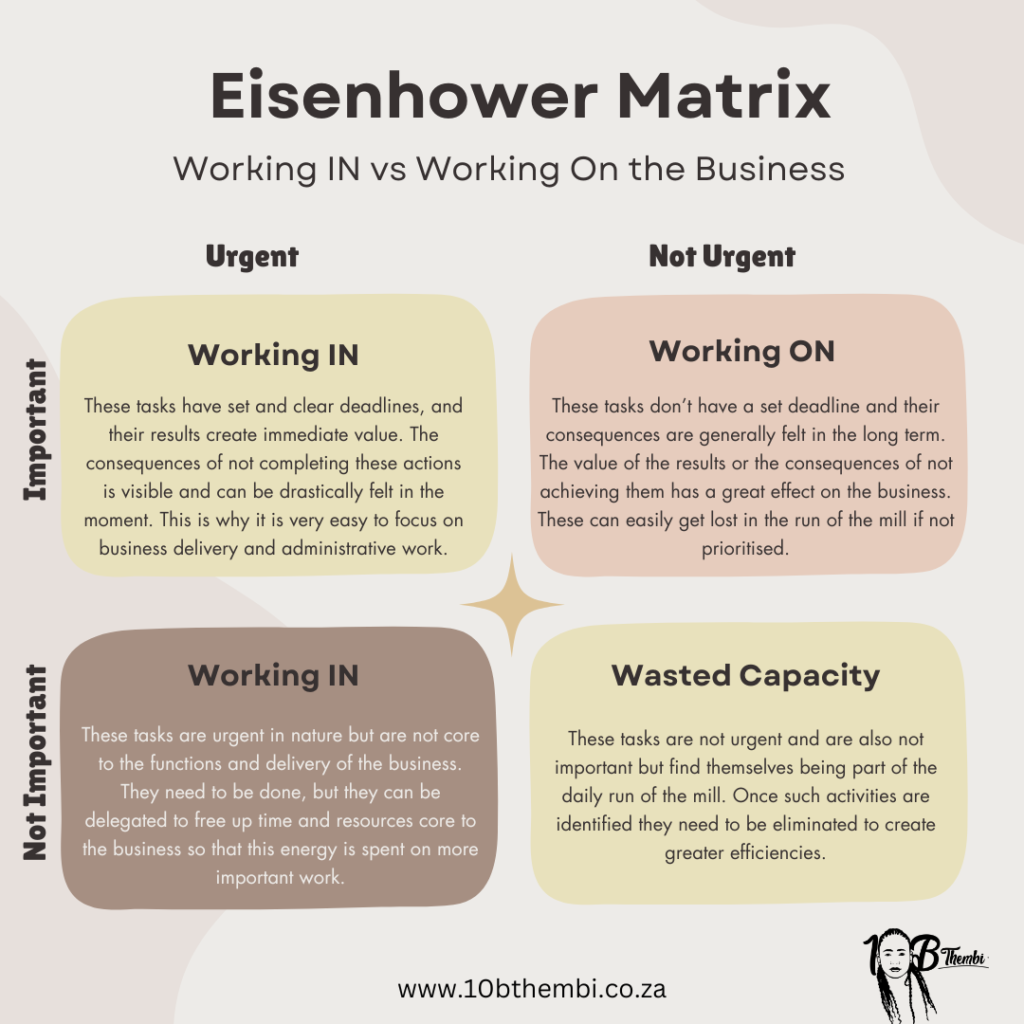
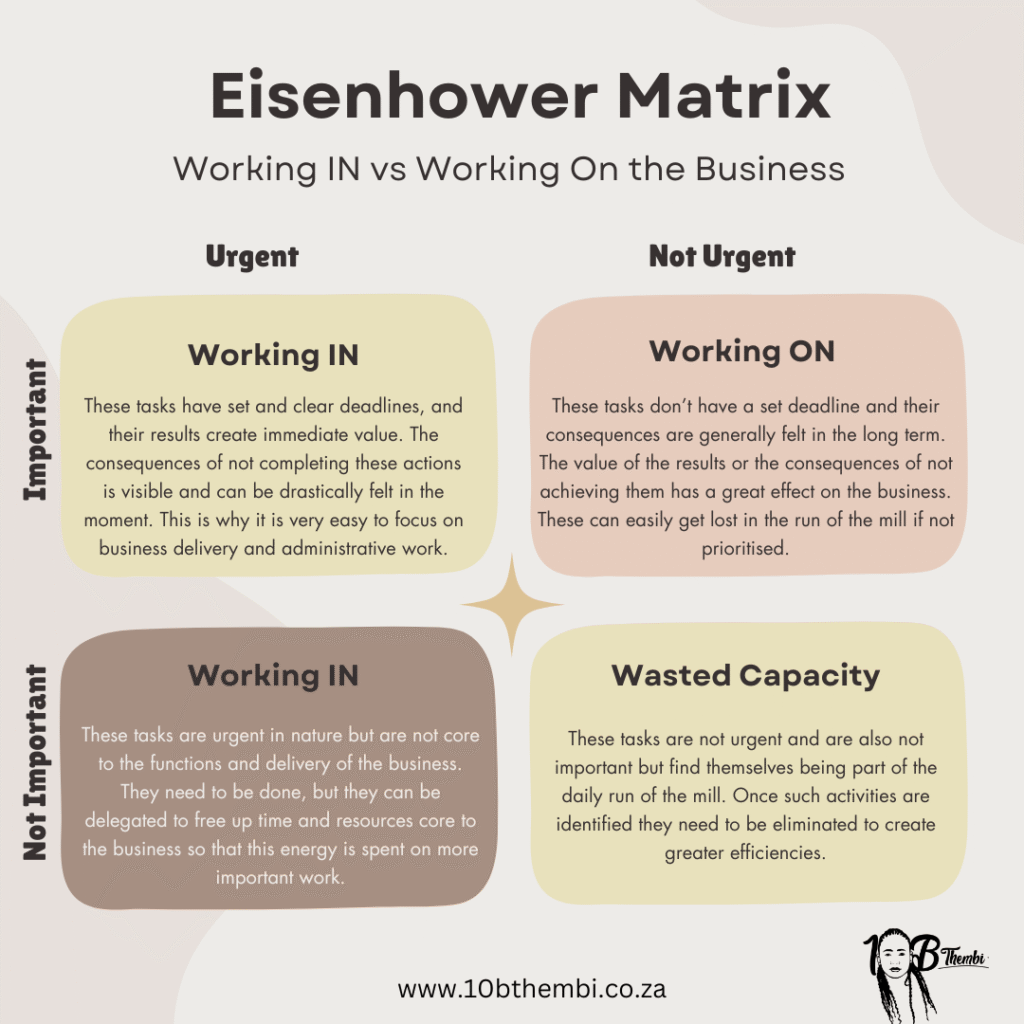
As an entrepreneur, you need to balance working IN versus working ON the business. Working IN the business brings about short-term much-needed benefits whilst working on the business brings longer-term growth and sustainability. Looking at the Eisenhower matrix, Working IN the business generally falls under the “Urgent and Important” whilst working on the business can be seen as “Not Urgent but Important”.
This concept of working IN vs working ON is not only for entrepreneurs and business owners but can be used by management when developing and growing their departments and teams. The main principle becomes how do you lift your head from the day-to-day grind to focus on things that will make the enterprise succeed without you. Being indispensable intrinsically makes one feel special but it is a higher form of leadership to work oneself out of being indispensable to create a legacy of sustainability and scalability.
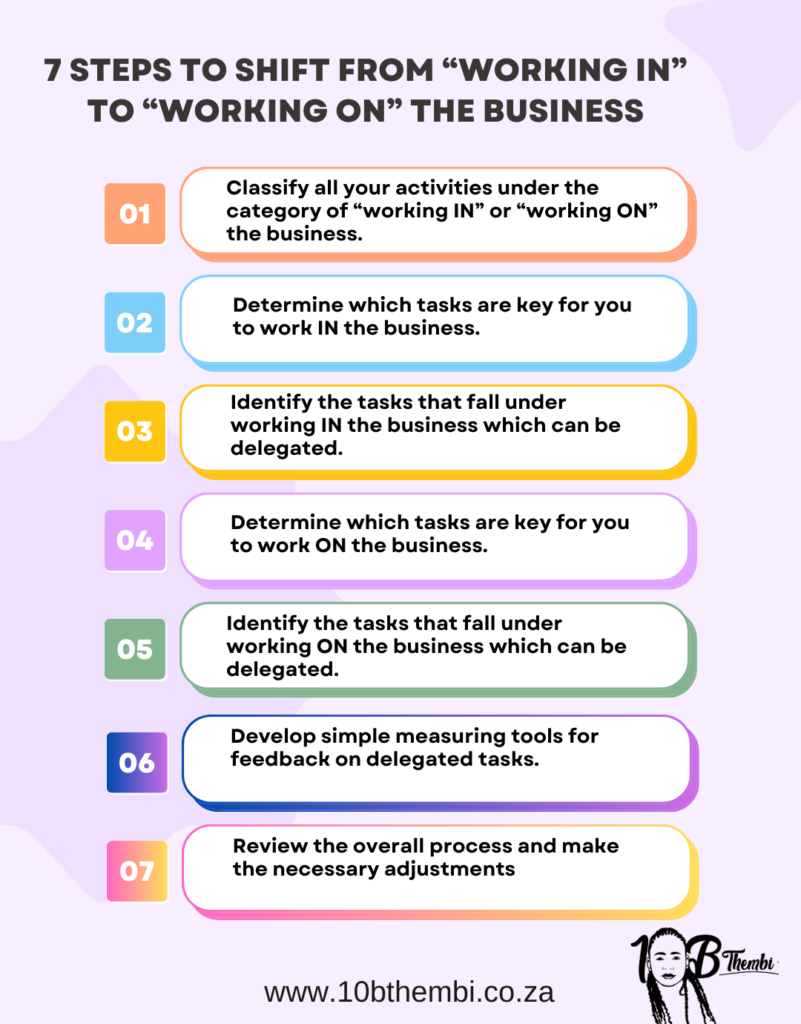
Below are 7 steps to creating a shift from working IN to working ON:
- Outline your activities and classify them under the category of “working IN” or “working ON” the business.
- Determine which tasks are key for you to work IN the business. It is important to note that this switch can take time to happen. Quickly dropping key tasks that you are key in whilst working IN the business can lead to more damage than good. It is best to plan the transition and find a suitable replacement for those particular roles that you play.
- Identify the tasks that fall under working IN the business that you can outsource and give to other team members or external contractors to manage.
- Determine which tasks are key for you to work ON the business. It is then imperative to prioritise these as the business owner as you build the business to become the ecosystem that will serve you in the long run.
- Identify the tasks that fall under working ON the business that you can also outsource and give to other team members or external contractors to perform.
- Develop a simple measuring tool to track these tasks so you have a meaningful feedback mechanism to see if these delegated tasks are yielding the desired results as planned.
- Review the overall progress and make the necessary adjustments as you build this new skill into the business.
Sometimes the changes need to be drastic but most of the time small consistently measured outcomes yield the best benefits. As the Chinese proverb says, “A journey of a thousand miles begins with a single step”. Taking the steps to improve yourself and your business will yield results if you remain consistent in growth, refining what works and discarding what does not work.

The Weight of Leadership: Decision-Making Under Uncertainty
Leadership isn’t just about power—it’s about responsibility.
As leaders and business owners, we often find ourselves in situations where we must make tough decisions with limited information. From the outside, leadership can look like authority and influence, but on the inside, every choice carries weight. The higher you go, the more complex the decisions become.
If you aspire to grow as a leader, you must get comfortable making decisions despite uncertainty. Yes, it’s daunting. Yes, you might get it wrong. But making mistakes is part of the process. What separates great leaders from the rest is their ability to refine their decision-making process and adapt when things don’t go as planned.
My team often comments on my ability to make decisions and chart a way forward with limited information. Over time, working with limited information has become normal to me—but it wasn’t always that way. It’s a muscle that needs to be exercised to grow.

What holds us back is the fear of making mistakes.
So why are we scared of mistakes? Let’s start with what fear is. Fear is an innate protection mechanism designed to keep us safe from danger and ultimately alive for longer. When there is the unknown, there is the possibility of danger—where we can get hurt, whether physically, emotionally, or financially. Fear is a caution to what may happen, and rather than fighting against it, it is best to work with it and build mitigating measures that help minimise risk. Minimising risk is not the same as eliminating it, but it is a far better way to manage uncertainty.
We’ve all heard the saying, “Do it scared.” And although it’s true, we must also use fear as a tool—to help mitigate risk.
So, how do you build your decision-making muscle?
To help navigate fear and uncertainty, structured decision-making models can serve as helpful guides. Let’s explore three that have made a tangible impact on how I lead:
1. Adopt a Decision-Making Framework
Relying purely on intuition can be risky. A structured framework ensures your decisions are well thought out. If you’re more of an unstructured person like me, the idea of a framework may put you off—but hear me out. For me, structure is less about rigid theory and more about having mental checkboxes that guide my thinking.
Here are three practical models:
The OODA Loop (Observe, Orient, Decide, Act)
Originally developed by military strategist John Boyd, this model helps leaders make fast, effective decisions in dynamic and fast-paced environments.
• Observe – Gather as much relevant information as possible. Get comfortable with the idea that you may not have all the data you need—but you must be willing to work with just enough.
• Orient – Analyse the data, considering internal and external factors. It’s important to think through the information in concert with all the other available elements. One common mistake I’ve seen leaders make is viewing data only from their own lens. Even if you’re confident in your view, analysing different perspectives will enrich your final decision.
• Decide – Make a choice based on the best available insights. Remember in math class when teachers asked you to show your steps, not just your answer? That applies to leadership too—the reasoning behind your decision often carries more weight than the decision itself. Be clear about your intent and thought process.
• Act – Implement the decision while staying agile enough to adjust if needed. Avoid analysis paralysis. In some cases, precision is crucial (like in engineering); in others, you can iterate and refine. If you realise you got it wrong, reflect, identify the improvement points, and make the necessary adjustments. Action is what gets things done.
This framework is especially useful when time is tight and the pressure is high.
The Eisenhower Matrix (Urgent vs. Important)
Not all decisions require immediate action. This is one of my favourite—and most sobering—tools. The Eisenhower Matrix helps leaders prioritise effectively:
• Urgent & Important – Do it now.
• Important but Not Urgent – Schedule it.
• Urgent but Not Important – Delegate it.
• Neither Urgent nor Important – Eliminate it.
I’ve learned that urgent tasks are not always important—and important tasks are not always urgent. In business, I’ve seen crucial areas like marketing, tracking metrics, and team development get sacrificed for the day-to-day demands of client service. The sad reality is that if you don’t make time for the important, the urgent—and sometimes not important—will fill the vacuum. Use this matrix to reflect and adjust your strategy.

The 10/10/10 Rule
Pioneered by Suzy Welch, this rule helps you evaluate decisions with a long-term view:
• How will I feel about this in 10 minutes?
• How will I feel about this in 10 months?
• How will I feel about this in 10 years?
This method is powerful because it encourages long-term thinking rather than short-term emotional reactions. My personal rule: don’t sacrifice long-term goals for momentary fulfilment. This tool is particularly useful for personal and ethical decisions that can carry emotional weight.
2. Think Through Multiple Scenarios
When making decisions, don’t just focus on what could go right—also consider what could go wrong. I often joke in meetings, “What’s the worst that could happen?” But it’s actually a useful mindset.
Use scenario planning to prepare for different outcomes:
Best-case scenario – What if everything goes perfectly?
Worst-case scenario – What’s the worst that could happen?
Most probable scenario – What’s the likely outcome based on facts?
Thinking through these scenarios enables you to prepare and create backup plans for most eventualities. The planning stage shouldn’t be overlooked—it helps mitigate real risks.
Leaders who consistently consider multiple possibilities are far better equipped to deal with challenges and surprises.
3. Always Have a Mitigation Strategy
Even with the best planning, things don’t always go as expected. That’s why risk mitigation is essential. Ask yourself:
- If this decision turns out to be wrong, how can I pivot?
- Who do I need to communicate with if things go off track?
- What safety nets can I put in place to minimise damage?
Great leaders don’t just make decisions—they build resilience into their decision-making process. As a leader, you won’t always get it right—so always have a backup… of a backup… of a backup.
Final Thoughts: Decide. Lead. Grow.
At its core, leadership is about taking responsibility for choices, adapting to outcomes, and learning along the way. The best leaders aren’t the ones who never make mistakes—they’re the ones who make thoughtful, informed decisions, adjust when needed, and keep leading.
So next time you face a tough call, remember: it’s not just about the power and authority of leadership—it’s about embracing the responsibility that comes with it.
Lean in. Decide. Grow.
#Leadership #DecisionMaking #Growth #RiskManagement #BusinessLeadership