Blog Grid Light
- Home
- Blog Grid Light
Leadership Lessons from Proverbs: Timeless Wisdom for Today’s Leaders
Leadership has always fascinated me. Over the years, running my businesses and leading teams, I’ve realised leadership isn’t just about making decisions or holding a title. It’s about service, impact, and integrity.
One of the places I draw the deepest wisdom from is the book of Proverbs. Solomon, the wisest king, didn’t ask God for riches or fame—he asked for wisdom so he could govern people well. That always humbles me, because it reminds me to check my motives: am I leading for myself, or for the people I’ve been entrusted to serve?
In today’s business, community, and family contexts, these principles remain as powerful as ever. Here are the seven leadership lessons from Proverbs that continue to shape my journey—and I believe they can transform yours too.
1. Servant Leadership: Leading with Purpose
When Solomon asked for wisdom, it wasn’t for himself but to serve the people. That’s servant leadership: putting people’s growth, wellbeing, and development first. Instead of focusing on recognition or power, servant leaders empower their teams, build trust, and foster collaboration.
I’ve seen this in my own company. Sometimes, my role isn’t to come up with all the answers, but to create an environment where my team can thrive. For example, when a new technician joins an event setup, I make sure they’re not just told what to do but also mentored through the process. It takes more time upfront, but I’ve seen how it builds loyalty and competence in the long run.
Servant leadership also takes listening to my team and not just making things about what I want and how I see them. When we serve others, it empowers them to serve our goals and visions as leaders.
Reflective question: Why do you want to lead? Is it for recognition, or to serve and uplift others?
2. Mentorship and Advisors: Building Your Circle
Proverbs says: “Walk with the wise and become wise.” That’s not theory—that’s life.
Leadership isn’t a solo journey. I recently picked this model up from Dan Martell, and it has put to words what has worked for me over the years.
You need three kinds of people in your circle:
– Mentors – those who are far ahead and rich in experience.
– Advisors – people who have “done it before” and can guide you through specific steps.
– Peers – colleagues who grow alongside you and hold you accountable.
I’ve had mentors who were 10–15 years ahead of me, and their guidance saved me from mistakes that could have cost me years. Advisors have been equally crucial. When I was bootstrapping my business, I leaned on people who had already negotiated big contracts and supplier dieals. Their tips—like how to structure payment terms or how to do importing —gave me an edge. There experiences and lessons saved me a huge amount of time and money of which I am truly grateful.
And then there are peers. I remember sitting in a rooms with fellow founders and business owners at different events and conferences. Just hearing their stories reminded me I wasn’t alone in the grind. That’s the value of peers: they sharpen you while walking the same road.
In today’s digital age, mentors and advisors aren’t limited to proximity. Books, podcasts, and online communities open doors to world-class guidance.
3. Speaking Life: The Power of Words
Proverbs teaches us: “Those who guard their lips preserve their life.” As a leader, what you say matters—more than you realise.
It matters what you say about yourself and it also matters what you say about others. When you say good things about yourself, they are reinforced and you perform accordingly. As a leaders, your words can build or destroy morale, culture, and trust. Your feedback should always aim t be constructive, even when it is tough. Leadership feedback should lift people higher, not break them down.
I once had a young team member who made a serious mistake during an event. I was frustrated, but instead of scolding her, I sat her down and explained how we could fix it and what to do next time. Today, she’s one of the most dependable people on our crew. If I had only spoken criticism, and ranted in frustration, I would have crushed her spirit.
Pro Tip: Don’t just criticise mistakes — point people towards solutions and a better way
4. Diligence: The Work No One Sees
“The desires of the diligent are fully satisfied.”
Leadership may look glamorous, but true impact happens in the unseen hours: preparing strategies, refining plans, negotiating stakeholders, and ensuring payroll gets paid. Most people see the event lights, the sound systems, completed projects, the reverence and the applause. They don’t see the late nights in the warehouse testing equipment, or the endless spreadsheets balancing plans and payroll. That’s the unseen grind of leadership—diligence.
Great leaders stay consistent — showing up even when motivation fades.
Remember: progress is better than great ideas not actioned.
Reflective question: What have you done this week to move closer to your goals?
5. Discipline: Talent Needs Structure
Proverbs warns: “Whoever disregards discipline comes to poverty and shame.”
Talent may get you recognised, but discipline sustains your leadership. It’s easy to rely on talent, but discipline is what makes people trust you. Discipline means being reliable, accountable, and consistent, even in small commitments.
The biggest struggles for me are staying consistent with committments to myself. The choice to eat right, exercise and do tasks that are just for me. It is easy to sacrifice myself but I have had to realise and accept that this is also part of discipline and I need to work and master it. It’s not about perfection — it’s about being humble enough to accept correction and strong enough to stay the course.
6. Integrity: Doing Right When No One is Watching
“Righteousness guards the person of integrity.” Integrity is the foundation of trust. It’s not measured by how you act publicly, but by the choices you make privately. Integrity is a big one for me, especially living in South Africa where corruption is a daily headline. But integrity starts small, its starts with “me” and not just the “others”.
True integrity often costs something, but without it, leaders eventually fall.
7. Decision-Making: Choose, Don’t Drift
Indecision costs more than a wrong decision corrected. Proverbs says, “All who are prudent act with knowledge, but fools expose their folly.” Leaders must be decisive, using wisdom, knowledge, and contingency planning to navigate uncertainty.
I’ve learned that making no decision is worse than making a wrong one and correcting it. In moments of indecision I have realised that what is paralysing me is the fear of getting it wrong and being exposed. It is the fear of hurting other people’s feelings. In a previous article, I spoke about fear and how it is a protection mechanism that we must work with to de-risk the situation but we must never allow it to work against us.
Conclusion
Proverbs isn’t just ancient wisdom—it’s leadership strategy for today. It offers a blueprint for effective leadership: serve first, surround yourself with the wise, speak life, stay diligent, practice discipline, walk in integrity, and make wise decisions.
When leaders apply these timeless principles, they not only grow themselves but also elevate their organisations, communities, and nations.
Leadership isn’t about the applause—it’s about the lives changed because you chose to lead with wisdom.
“Which of these Proverbs leadership lessons resonates with you most? Drop me a note or share this with a leader who needs it.”
What’s Stopping You? A Guide for Aspiring Entrepreneurs
The Courage to Start a Business
I’ve had many conversations with aspiring entrepreneurs who have brilliant business ideas but haven’t yet found the courage to start. Sometimes they’re still planning, researching, or saving — but more often, they have the idea, just not a plan.
These conversations challenged me to reflect on a common pattern: people postponing action and getting stuck in what I call perpetual paralysis. I want to unpack three key reasons why many people don’t take the first step — and how to overcome them.
1. Fear of Failure and Its Consequences
Insight: According to the Global Entrepreneurship Monitor (GEM) Report, fear of failure ranks among the top three reasons people don’t start businesses — globally. This isn’t just a South African problem. Fear transcends geography, culture, and background.
Why is failure so frightening? Because we often tie it to our identity. We don’t just see it as a situation — we internalise it as a reflection of our worth. Underlying fears include:
- Fear of financial loss
- Fear of judgement from peers or family
- Fear of damaging our own self-esteem

Fear is natural — it’s a built-in mechanism to detect danger and protect us. The trick is not to ignore it, but to understand and manage it. Use fear as a signal to assess risks more clearly and build contingency plans.
My story: When I wanted to expand my events business to include LED screens, I was afraid. It required a significant investment in equipment, with no guarantee of returns. I was also venturing into importing gear for the first time — new suppliers, agents, and shipping risks.
So, I sought guidance from someone who had done it before. Their mentorship helped me navigate the process and ease the fear. Was I still scared? Yes — but with each step forward, things became clearer. Clarity grows with motion and not stillness.
Fear doesn’t disappear. But it loses its grip when you move. Reframe failure as feedback. Every successful entrepreneur has failed — and learned from it.
If you can’t find a mentor nearby, use the internet. YouTube, Google, podcasts — they bring the world’s best advice to your fingertips at little or no cost.
2. Not Knowing Where to Start
Insight: Having an idea is not the same as having a plan. A plan is a sequence of actionable steps that take you from concept to execution.
So, where do you begin? Start with what you know and start small.
Ask:
- Operate from home
- Build your website with AI tools or free website builders
- Use WhatsApp and social media to market
- Look for customers within your current network
- Use tools like ChatGPT, Gemini, or Deekseek for marketing copy

Can you collaborate with someone to share resources?
Example: If you’re delivering goods, you don’t need a car at first — consider Uber, Bolt, or courier services. Think frugally, creatively, and practically.
Do not feel under pressure to do things like all the mainstream guys. Look at doable ways of cutting costs without sacrificing the quality of your service.
Raise capital through presales and deposits, but be precise about your costing. As a client, I became frustrated when small business owners have made me pay money upfront, and midway through the service, they came back asking for more money to finish the job. Don’t be the entrepreneur who asks for more money mid-job because they miscalculated. Let the maths “maths.”

My story: When I started my events business, I had passion and a small car — not much else. I found a supplier who rented out the same sound equipment I wanted to own. I built a website with my own IT skills, added a markup, and promoted it using SEO and Google Ads.
When clients booked me, I hired equipment from the supplier or outsourced the job while learning and profiting. This approach validated my idea, helped me understand market demand, and guided my future investments.
Without this step-by-step approach, I might have spent money on equipment no one really wanted. I see many startups make this mistake. Don’t let that be you.
In Closing
You may have to start scared — but start smart. Use what you know, start small, and validate your idea. The little you have can grow into something great if you stay committed and invest in your growth and never give up.
It takes faith to start a business — because you’re stepping into the unknown. But remember:
Faith without action is dead. Your dreams are waiting for you to act.
- What do I know about this business?
- What do I still need to learn?

Starting in a familiar field builds confidence and business acumen. Business has many moving parts — sales, marketing, service delivery, customer support, staff management, and more. Starting in completely unfamiliar territory can overwhelm you early on and increase the risk of failure.
Once you have your idea, identify the problem you’re solving. Test the solution with your audience. Can you run a survey? Try a soft launch with sample stock?
Research and connect with people in the industry. In Zulu, we say: “Indlela ibuzwa kwabaphambili” — “Ask for direction from those ahead.” Don’t let pride or fear keep you from asking questions. You’ll save time, money, and stress by listening and heeding to the experiences of others.
Adopt a growth mindset. This means believing that your skills and intelligence can be developed through dedication, hard work and a commitment to learning. It is anchored on the premise that challenges and obstacles build fortitude and are a part of growth. So, embrace the challenges — they’re part of the journey.
Summary:
- Start with what you know
- Define the problem you’re solving
- Start small and test your idea
- Research and connect with industry players
- Build a growth mindset
3. Not Having the Money to Start
Most businesses don’t start with big capital. In fact, over 60% of SMEs globally start with personal savings or no capital at all. It is best to start with what you have and start small. How can you use your skills, knowledge and relationships to assist you with starting?
Start lean. Use what you have:
- Operate from home
- Build your website with AI tools or free website builders
- Use WhatsApp and social media to market
- Look for customers within your current network
- Use tools like ChatGPT, Gemini, or Deekseek for marketing copy
Can you collaborate with someone to share resources?
Example: If you’re delivering goods, you don’t need a car at first — consider Uber, Bolt, or courier services. Think frugally, creatively, and practically.
Do not feel under pressure to do things like all the mainstream guys. Look at doable ways of cutting costs without sacrificing the quality of your service.
Raise capital through presales and deposits, but be precise about your costing. As a client, I became frustrated when small business owners have made me pay money upfront, and midway through the service, they came back asking for more money to finish the job. Don’t be the entrepreneur who asks for more money mid-job because they miscalculated. Let the maths “maths.”
My story: When I started my events business, I had passion and a small car — not much else. I found a supplier who rented out the same sound equipment I wanted to own. I built a website with my own IT skills, added a markup, and promoted it using SEO and Google Ads.
When clients booked me, I hired equipment from the supplier or outsourced the job while learning and profiting. This approach validated my idea, helped me understand market demand, and guided my future investments.
Without this step-by-step approach, I might have spent money on equipment no one really wanted. I see many startups make this mistake. Don’t let that be you.
In Closing
You may have to start scared — but start smart. Use what you know, start small, and validate your idea. The little you have can grow into something great if you stay committed and invest in your growth and never give up.
It takes faith to start a business — because you’re stepping into the unknown. But remember:
Faith without action is dead. Your dreams are waiting for you to act.

The Weight of Leadership: Decision-Making Under Uncertainty
Leadership isn’t just about power—it’s about responsibility.
As leaders and business owners, we often find ourselves in situations where we must make tough decisions with limited information. From the outside, leadership can look like authority and influence, but on the inside, every choice carries weight. The higher you go, the more complex the decisions become.
If you aspire to grow as a leader, you must get comfortable making decisions despite uncertainty. Yes, it’s daunting. Yes, you might get it wrong. But making mistakes is part of the process. What separates great leaders from the rest is their ability to refine their decision-making process and adapt when things don’t go as planned.
My team often comments on my ability to make decisions and chart a way forward with limited information. Over time, working with limited information has become normal to me—but it wasn’t always that way. It’s a muscle that needs to be exercised to grow.

What holds us back is the fear of making mistakes.
So why are we scared of mistakes? Let’s start with what fear is. Fear is an innate protection mechanism designed to keep us safe from danger and ultimately alive for longer. When there is the unknown, there is the possibility of danger—where we can get hurt, whether physically, emotionally, or financially. Fear is a caution to what may happen, and rather than fighting against it, it is best to work with it and build mitigating measures that help minimise risk. Minimising risk is not the same as eliminating it, but it is a far better way to manage uncertainty.
We’ve all heard the saying, “Do it scared.” And although it’s true, we must also use fear as a tool—to help mitigate risk.
So, how do you build your decision-making muscle?
To help navigate fear and uncertainty, structured decision-making models can serve as helpful guides. Let’s explore three that have made a tangible impact on how I lead:
1. Adopt a Decision-Making Framework
Relying purely on intuition can be risky. A structured framework ensures your decisions are well thought out. If you’re more of an unstructured person like me, the idea of a framework may put you off—but hear me out. For me, structure is less about rigid theory and more about having mental checkboxes that guide my thinking.
Here are three practical models:
The OODA Loop (Observe, Orient, Decide, Act)
Originally developed by military strategist John Boyd, this model helps leaders make fast, effective decisions in dynamic and fast-paced environments.
• Observe – Gather as much relevant information as possible. Get comfortable with the idea that you may not have all the data you need—but you must be willing to work with just enough.
• Orient – Analyse the data, considering internal and external factors. It’s important to think through the information in concert with all the other available elements. One common mistake I’ve seen leaders make is viewing data only from their own lens. Even if you’re confident in your view, analysing different perspectives will enrich your final decision.
• Decide – Make a choice based on the best available insights. Remember in math class when teachers asked you to show your steps, not just your answer? That applies to leadership too—the reasoning behind your decision often carries more weight than the decision itself. Be clear about your intent and thought process.
• Act – Implement the decision while staying agile enough to adjust if needed. Avoid analysis paralysis. In some cases, precision is crucial (like in engineering); in others, you can iterate and refine. If you realise you got it wrong, reflect, identify the improvement points, and make the necessary adjustments. Action is what gets things done.
This framework is especially useful when time is tight and the pressure is high.
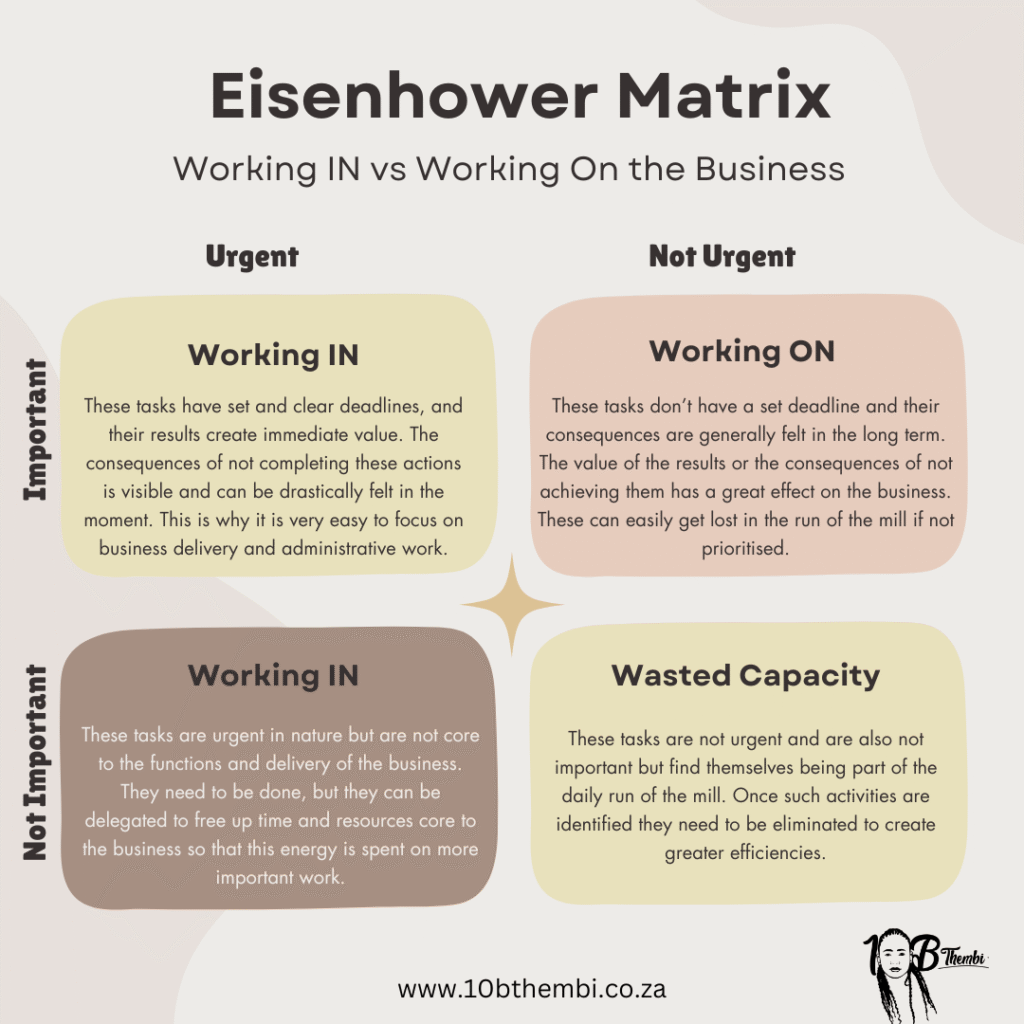
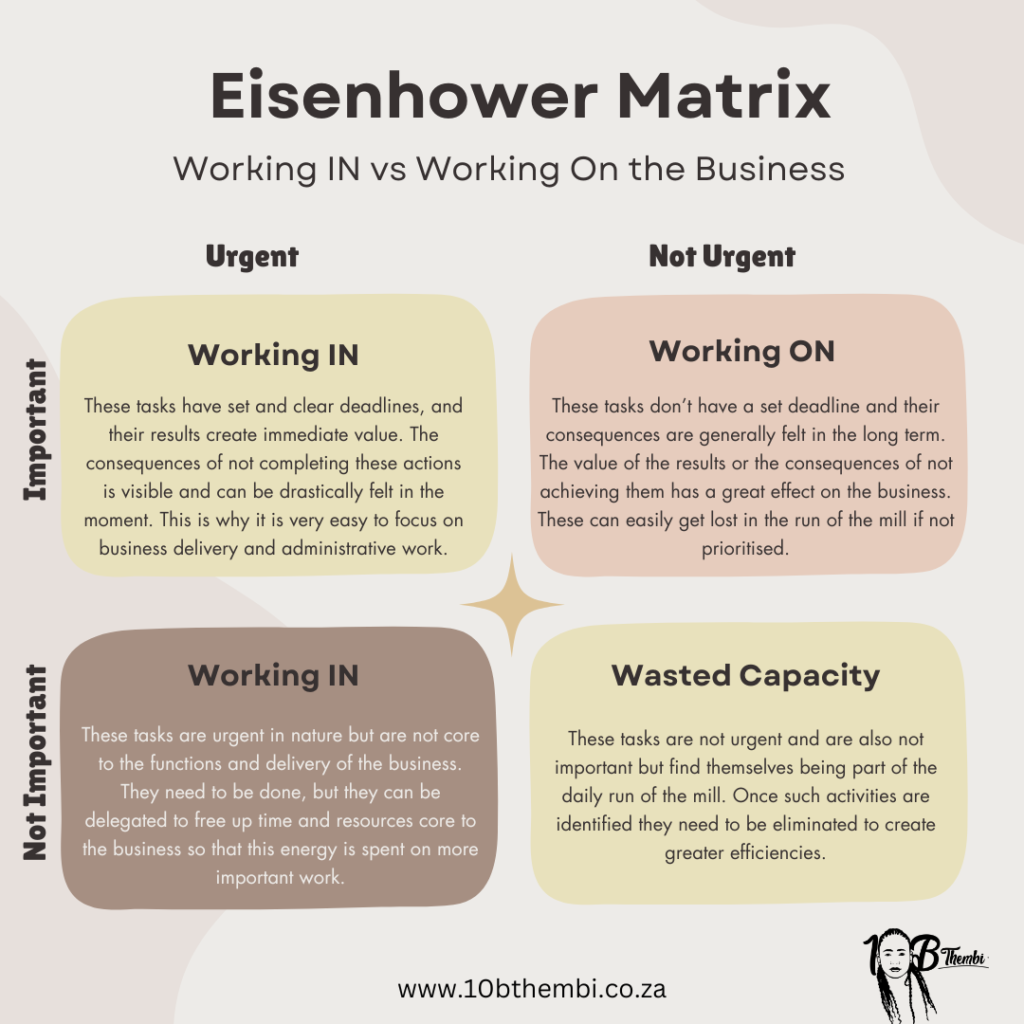
The Eisenhower Matrix (Urgent vs. Important)
Not all decisions require immediate action. This is one of my favourite—and most sobering—tools. The Eisenhower Matrix helps leaders prioritise effectively:
• Urgent & Important – Do it now.
• Important but Not Urgent – Schedule it.
• Urgent but Not Important – Delegate it.
• Neither Urgent nor Important – Eliminate it.
I’ve learned that urgent tasks are not always important—and important tasks are not always urgent. In business, I’ve seen crucial areas like marketing, tracking metrics, and team development get sacrificed for the day-to-day demands of client service. The sad reality is that if you don’t make time for the important, the urgent—and sometimes not important—will fill the vacuum. Use this matrix to reflect and adjust your strategy.

The 10/10/10 Rule
Pioneered by Suzy Welch, this rule helps you evaluate decisions with a long-term view:
• How will I feel about this in 10 minutes?
• How will I feel about this in 10 months?
• How will I feel about this in 10 years?
This method is powerful because it encourages long-term thinking rather than short-term emotional reactions. My personal rule: don’t sacrifice long-term goals for momentary fulfilment. This tool is particularly useful for personal and ethical decisions that can carry emotional weight.
2. Think Through Multiple Scenarios
When making decisions, don’t just focus on what could go right—also consider what could go wrong. I often joke in meetings, “What’s the worst that could happen?” But it’s actually a useful mindset.
Use scenario planning to prepare for different outcomes:
Best-case scenario – What if everything goes perfectly?
Worst-case scenario – What’s the worst that could happen?
Most probable scenario – What’s the likely outcome based on facts?
Thinking through these scenarios enables you to prepare and create backup plans for most eventualities. The planning stage shouldn’t be overlooked—it helps mitigate real risks.
Leaders who consistently consider multiple possibilities are far better equipped to deal with challenges and surprises.
3. Always Have a Mitigation Strategy
Even with the best planning, things don’t always go as expected. That’s why risk mitigation is essential. Ask yourself:
- If this decision turns out to be wrong, how can I pivot?
- Who do I need to communicate with if things go off track?
- What safety nets can I put in place to minimise damage?
Great leaders don’t just make decisions—they build resilience into their decision-making process. As a leader, you won’t always get it right—so always have a backup… of a backup… of a backup.
Final Thoughts: Decide. Lead. Grow.
At its core, leadership is about taking responsibility for choices, adapting to outcomes, and learning along the way. The best leaders aren’t the ones who never make mistakes—they’re the ones who make thoughtful, informed decisions, adjust when needed, and keep leading.
So next time you face a tough call, remember: it’s not just about the power and authority of leadership—it’s about embracing the responsibility that comes with it.
Lean in. Decide. Grow.
#Leadership #DecisionMaking #Growth #RiskManagement #BusinessLeadership
Building your business for scale.
Ever wondered why some businesses grow over time and become very good at what they do? As business owners, we are faced with many interesting challenges. Core to this is being the visionary and the main driver to bring the vision to life. With a small to medium enterprise, there are many balls to juggle as you build your enterprise and your team. You can easily find yourself being all things to all men, as you may be core in most of the departments within the business, which does not lend itself well to growth and scale.
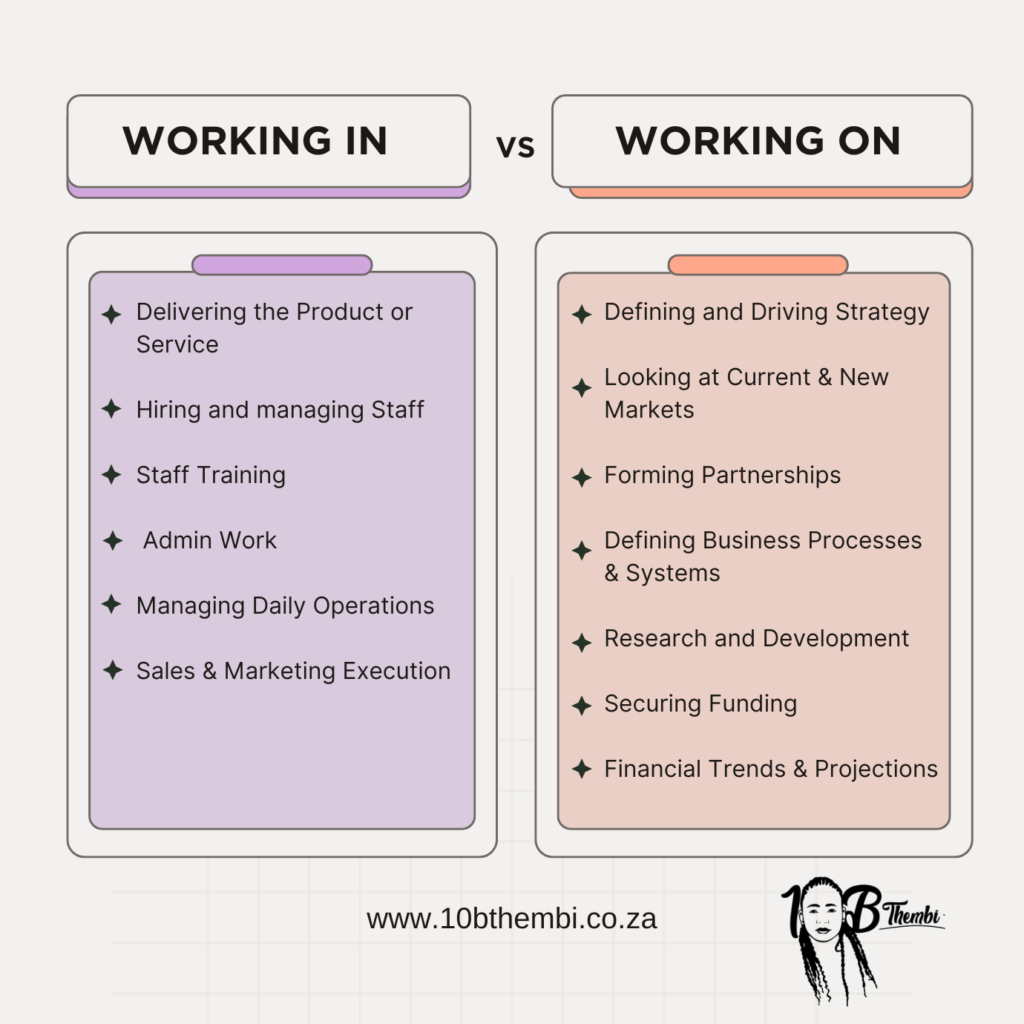
Here enters the concept of working IN versus working ON your business, coined by Michael Gerber in his book The E-Myth Revisited. Working IN the business is when you are doing work that fulfils the promise that your business has made to customers. This can take the form of working on a client project physically or mentally. This also includes the design and manufacturing of the product that the client will eventually pay for. Operationally it can take the form of managing people, where you monitor and guide them to deliver the excellence that the business demands. The general truth is that you are generally your “best employee” as the business owner. You can accomplish things right and lead the team best based on your vision. Many people such as your customers, staff, suppliers, and partners also rely on you a lot in the early stages as the business grows and matures.
Working ON the business speaks to things that build the business to be its own self-sustaining entity. These items are more strategic in nature and seek to divorce the business from relying solely on one individual, be it the owner or any key employees. These items can take the form of developing and documenting business processes. Processes can be defined as a set of steps needed to fulfil a predefined outcome. As entrepreneurs, we are generally good at thinking on our feet and solving problems, but this gift can cause challenges and frustrations when it comes to scaling the business.
Examples of business processes include documenting how the people already in the business onboard and train new staff. How do staff go about quoting for the different products and services? How do the people in the business deliver the products on a consistent basis to eliminate the dexterity that the employees will have to handle? What I have painfully learnt over the years is that the more complexity and need for dexterity there is for your team, the higher the likelihood of making mistakes.
When you bring on new staff, they generally need a process to follow for them to assimilate into the business, and thereafter creativity and improvement can take place. If this piece is missing, you generally find the owner or management pulled into even the smallest of decisions or crisis management which is not healthy.
Key to working ON the business is developing and monitoring the execution of the strategy. Strategy is thinking work and generally falls behind when it is in competition with the actual delivery that the business needs to achieve. Some strategic items that usually take a back seat include evaluating the current market and searching for new markets or new clients within the same market. Another item that can be neglected is the evaluation of staff performance and discussing key efficiencies that will lead to improvement over time. It also goes into analysing the financial health and funding of the business, shifting from being reactive to the numbers to being more proactive to the trends of the business and industry over time.
As an entrepreneur, you need to balance working IN versus working ON the business. Working IN the business brings about short-term much-needed benefits whilst working on the business brings longer-term growth and sustainability. Looking at the Eisenhower matrix, Working IN the business generally falls under the “Urgent and Important” whilst working on the business can be seen as “Not Urgent but Important”.
This concept of working IN vs working ON is not only for entrepreneurs and business owners but can be used by management when developing and growing their departments and teams. The main principle becomes how do you lift your head from the day-to-day grind to focus on things that will make the enterprise succeed without you. Being indispensable intrinsically makes one feel special but it is a higher form of leadership to work oneself out of being indispensable to create a legacy of sustainability and scalability.
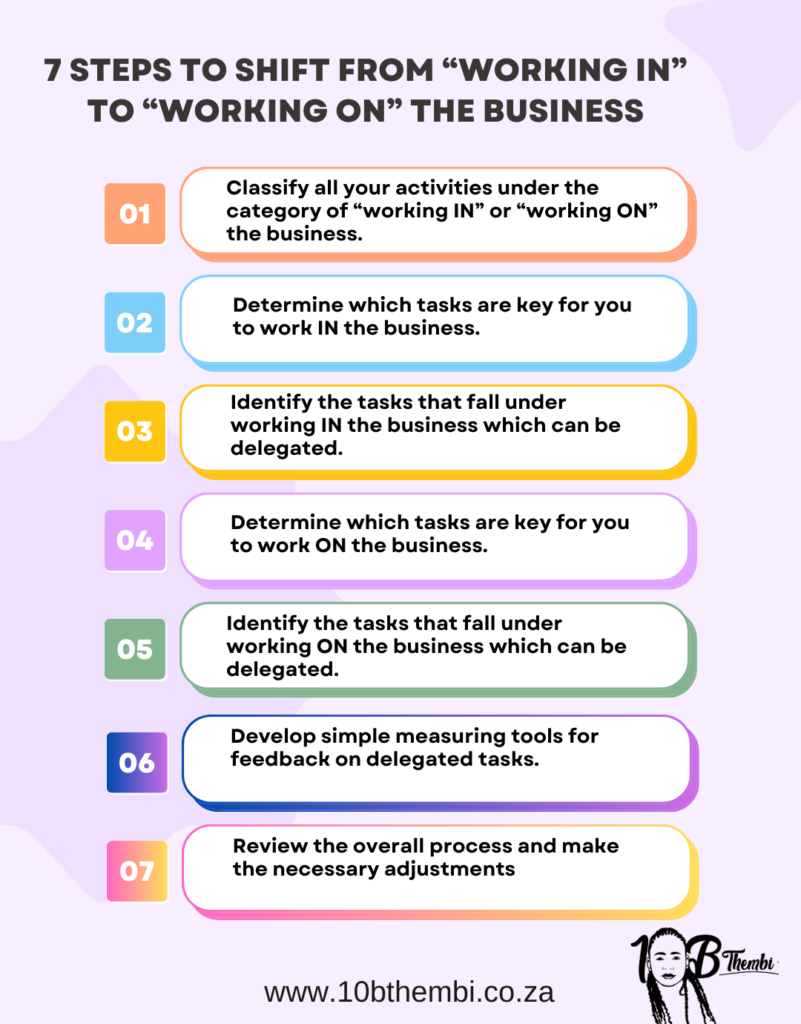
Below are 7 steps to creating a shift from working IN to working ON:
- Outline your activities and classify them under the category of “working IN” or “working ON” the business.
- Determine which tasks are key for you to work IN the business. It is important to note that this switch can take time to happen. Quickly dropping key tasks that you are key in whilst working IN the business can lead to more damage than good. It is best to plan the transition and find a suitable replacement for those particular roles that you play.
- Identify the tasks that fall under working IN the business that you can outsource and give to other team members or external contractors to manage.
- Determine which tasks are key for you to work ON the business. It is then imperative to prioritise these as the business owner as you build the business to become the ecosystem that will serve you in the long run.
- Identify the tasks that fall under working ON the business that you can also outsource and give to other team members or external contractors to perform.
- Develop a simple measuring tool to track these tasks so you have a meaningful feedback mechanism to see if these delegated tasks are yielding the desired results as planned.
- Review the overall progress and make the necessary adjustments as you build this new skill into the business.
Sometimes the changes need to be drastic but most of the time small consistently measured outcomes yield the best benefits. As the Chinese proverb says, “A journey of a thousand miles begins with a single step”. Taking the steps to improve yourself and your business will yield results if you remain consistent in growth, refining what works and discarding what does not work.

It’s the Destination that informs the Journey.
As humans, we were created with this innate curiosity to do and accomplish more than what we currently have. It’s that drive to explore and see what’s on the other side of the world. It’s the inquisitiveness to experience if we will actually fall off at the end of the flat earth once we reach the edge.
Although it may be intimidating to constantly hear of people who have their 10-step plan, and know exactly what they want in 5 years, have long and short-term plans, you too can achieve a lot of what you desire with the necessary action.
Some simple steps to move towards your desired destination
1. Have at least 1 thing that you are working towards
This step is sort of your guiding star. It is often said that life is about the journey more than the destination and that once you arrive at your destination, the journey starts again. I find this statement true, and for the journey to actualize there must be a desired destination that will inform the starting steps and guiding actions along the journey.
2. Feel free to explore your different interests
This is about trying different things that will help you learn more about yourself and discover various sides of you. The main drive is to not allow yourself to box yourself in. Once you have found what you are good at and enjoy doing, it’s okay to specialize but don’t limit yourself to only what you know. You too can surprise yourself with hidden talents and abilities that are within yourself. Always endeavor to stretch yourself.
3. Commit to excellence
Committing to excellence speaks to you doing what is right and excelling in what you do. This needs to be a part of you and has to inform your brand. Excellence will set you apart in a world full of people and constant self-promotion. Excellence will raise the quality of your relationships and your appeal. It will also lead to people recommending you to those who need the value that you bring. As the wise King Solomon puts it, “A man skillful in his craft will serve before kings”.
4. Invest in your development
You are your most valuable asset, and no one can invest in you as much as you can. There are various ways to develop yourself. This can be in the form of reading, podcasts, formal studies, being part of communities, mentorship, and just having conversations with people who are ahead of you in certain areas. The key is to expose yourself to new learnings and actually put into practice what you have learned so that it sticks and facilitates your growth.
5. Surround yourself with people who will challenge and inspire you to be the best you
This is about motivation and accountability. You need those people in your life who will celebrate you and your achievements, challenge you where you are going astray and show you that there is more to life. Your network is truly your net worth. The genuineness and reciprocity of these relationships will nourish your soul and give you the fuel to keep going when the going gets tough.
6. Start where you are
It’s interesting how we admire stories of people who have “made it” and have this expectation to hear this great and majestic voice of what to do next. When listening to all the stories of those we deem successful, the common thread is that everyone started where they were at, with what they had, and built on that. The compound interest of action is astounding. Constant small actions good or bad will over time yield great rewards or consequences and the key is to invest in the right actions.
On our way to our destination, the journey or process is the most valuable. At the end of it all, we treasure the experience we gain and the relationships and connections we build along the way. The destination is the compass whilst the journey is our life story. Keep taking those steps in your life story.